Bird · Dehesa & steppe
Otis tarda
● IUCN: vulnerable · EU Birds Directive Annex I
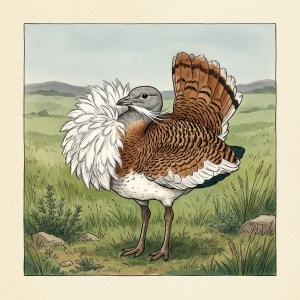
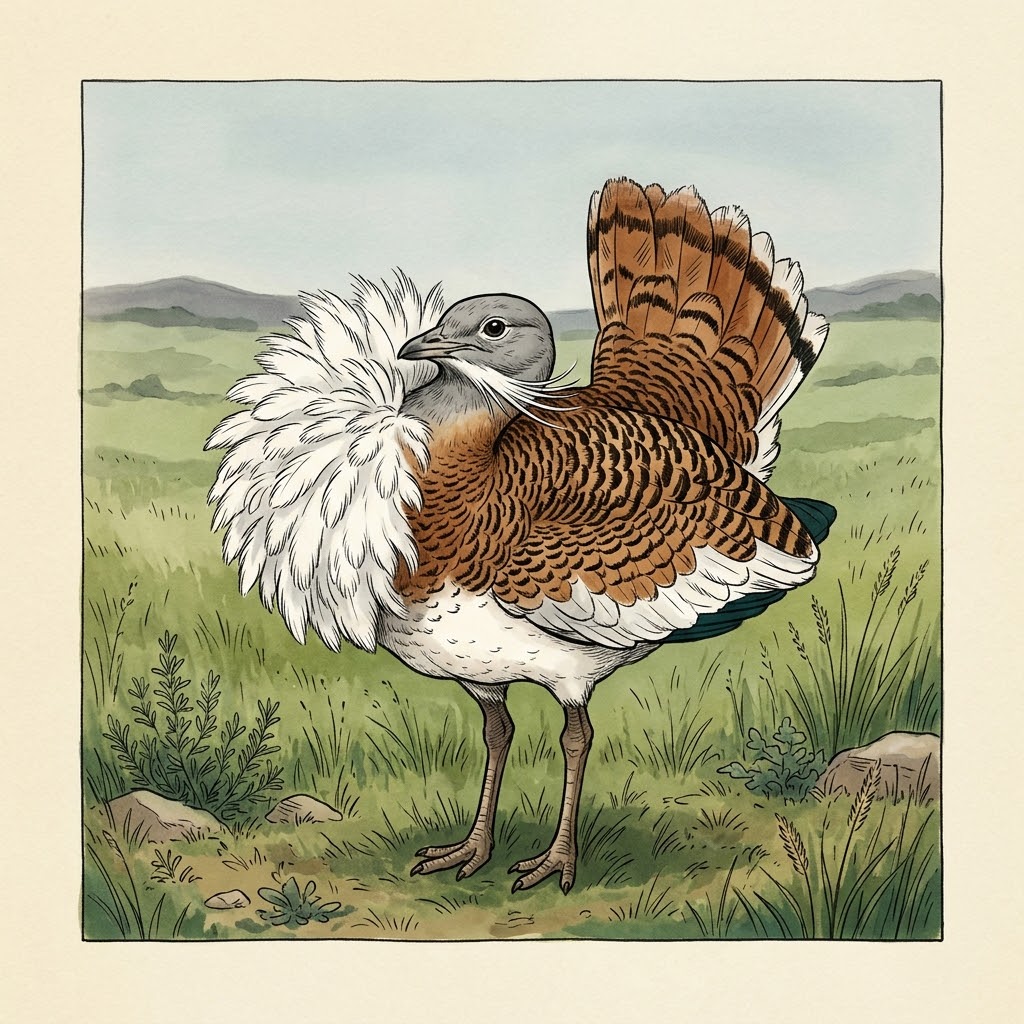
A male can weigh more than fifteen kilos, which makes the great bustard one of the heaviest birds still able to fly. In spring it turns itself into a foaming white ball of feathers that parades across the steppe. More than half of all the world’s great bustards live in Spain.
| Habitat | Open, flat cereal fields and fallow land without trees: the Spanish ‘steppe’ |
| Weight | Males 8–16 kg, females 3.5–5 kg |
| Active | By day, especially early morning and late afternoon |
Card I of IV
Ecological passport
| Identification | Heavy, turkey-like bird with a rust-brown, black-barred back and grey head and neck; males have long white ‘whiskers’ and a rusty breast band |
| Don’t confuse with | The little bustard, which is only the size of a pheasant and has a black-and-white neck |
| Diet | Plants, seeds and clover; in summer many grasshoppers and beetles, especially for the chicks |
Where can you see them?
Difficulty: ●●●●● Moderate
On the right plain you often see them in groups, but at a great distance. A telescope is almost essential.
| Extremadura | La Serena and the Llanos de Cáceres, the plains between Cáceres and Trujillo |
| Also good | Villafáfila in Zamora, the largest breeding area in Castilla y León |
| Tip | Watch from the car along farm tracks; getting out flushes them |
Did you know a male great bustard can be three times as heavy as a female? Few bird species show such a big difference between the sexes.
Card II of IV
Behaviour & season
Great bustards live in groups, males and females largely apart. In spring the males gather on traditional display grounds. There they turn their wings and tail inside out, puff up their throat and become a white ball of feathers visible from kilometres away. The females choose a male, incubate alone and lay their two or three eggs straight on the ground among the grain.
| Winter | Large flocks on the fields, easy to see |
| March – April | Display season: the males ‘foam’ on the display grounds |
| May – June | Incubation and chicks in the tall grain |
| Summer | Heat; flocks move to cooler fields or wander |
When is the best time to see them?
| Jan | Feb | Mar | Apr | May | Jun | Jul | Aug | Sep | Oct | Nov | Dec |
| winter flocks | display · best time | nesting | tall grain · heat | autumn & winter | |||||||
■ Good chance ■ Fair chance ■ Difficult
Card III of IV
Role in the ecosystem
The great bustard is the flagship of the Spanish grain steppe, a landscape shaped by centuries of dry farming. Together with the little bustard, the calandra lark and the stone-curlew it depends on a mosaic of grain, fallow and pasture. Its chicks eat huge numbers of grasshoppers, helping to keep insect plagues in check.
A steppe under pressure: irrigation, olive groves and vineyards, new solar farms and power lines are taking over the open land. Heavy birds like the bustard easily collide with cables. Agreements with farmers on later harvesting and fallow land help the species.
Card IV of IV
Stories & culture
The bird called ‘slow’
The Spanish name avutarda and the scientific tarda come from the Latin avis tarda, slow bird. That is not quite fair: the bustard walks deliberately but flies surprisingly fast. The Lagunas de Villafáfila in Zamora are among the most famous places in Europe to see it, with a visitor centre devoted entirely to the steppe.
Frequently asked questions
Questions about the great bustard
When can you see the great bustard display?
From mid-March to late April, especially early in the morning, when the males stand like white balls in the fields.
Where can you see great bustards in Spain?
In La Serena and the Llanos de Cáceres in Extremadura, and around Villafáfila in Zamora.
Is the great bustard the heaviest flying bird?
It is among the heaviest: big males weigh more than fifteen kilos. Only a few species, such as the kori bustard in Africa, come close.
Habitat · Spain