Crustacean · Atlantic coast
Pollicipes pollicipes
● Sensitive to overharvesting · strictly managed
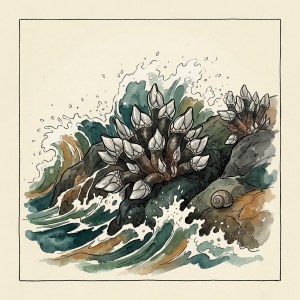
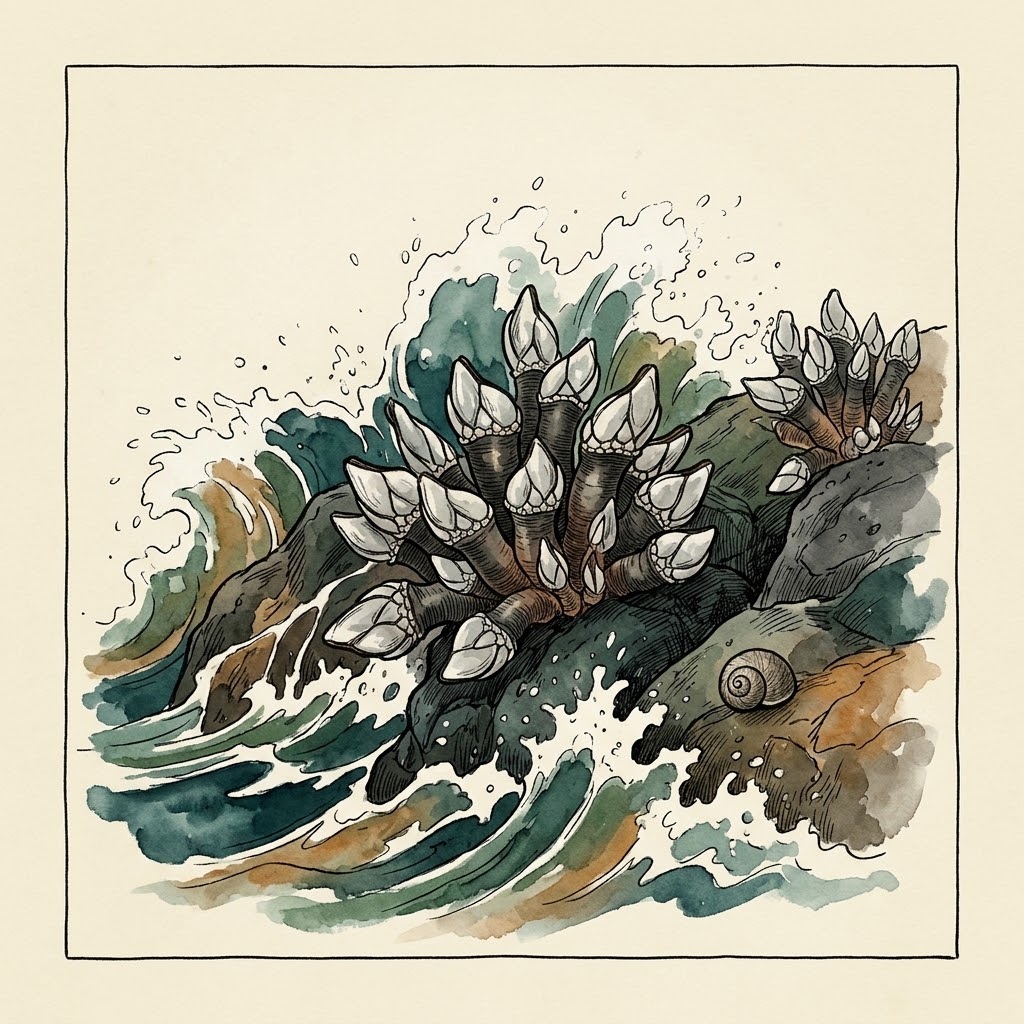
They look like tiny dinosaur hooves on a leathery stalk. Goose barnacles, percebes in Spanish, grow on the rocks where the Atlantic waves hit hardest. That is exactly where they taste best, and exactly why they are so expensive: around Christmas they are among the costliest seafoods in Spain.
| Habitat | Exposed rocks in the surf zone, between high and low tide |
| Size | Usually 3–8 cm long, in dense clusters |
| Active | Attached; filters food from the water as waves wash over it |
Card I of IV
Ecological passport
| Identification | Dense clusters with a leathery dark stalk topped by a white-grey ‘hoof’ of chalky plates |
| Don’t confuse with | The common mussel; despite its Dutch name the goose barnacle is not a mollusc but a crustacean, related to crabs and acorn barnacles |
| Diet | Plankton and small particles, caught with feathery legs from the surging water |
Where can you see them?
Difficulty: ●●●●● Fairly easy
At low tide you can see the clusters from safe rocks or clifftops; never go into the surf.
| Galicia | The Costa da Morte: Cabo Vilán near Camiñas and Punta do Roncudo near Corme |
| Also good | The coast around Cedeira and Cabo Ortegal, and the rocky shores of Asturias |
| Tip | Harvesting is only allowed for licensed percebeiros; look, but don’t pick |
Did you know the name goose barnacle comes from a medieval myth? People believed barnacle geese grew out of these shells, because nobody had ever seen their nests in the far north.
Card II of IV
Life cycle
A goose barnacle starts life as a tiny, free-swimming larva in the plankton. After a few weeks the larva looks for a spot to attach itself for good, preferably on the stalk of an adult goose barnacle. That is how the dense clusters form. From then on it spends its whole life on the same rock, catching food with feathery legs every time a wave washes over it.
| Spring – summer | Breeding; larvae in the plankton |
| Summer – autumn | Larvae attach to rocks and other goose barnacles |
| 1 to 2 years | Grow to edible size |
| Winter | Heavy storms; the clusters hold on tight |
When is the best time to see them?
| Jan | Feb | Mar | Apr | May | Jun | Jul | Aug | Sep | Oct | Nov | Dec |
| storm season · from a distance | calm sea · low tide · best time | autumn & Christmas | |||||||||
■ Good chance ■ Fair chance ■ Difficult
Card III of IV
From sea to plate
In Galicia percebes are harvested by percebeiros, one of the most dangerous jobs on the coast. They work at low tide on rocks pounded by the waves. The harvest is strictly regulated by local fishermen’s guilds: only licence holders may harvest, there are daily quotas and some rocks are closed for a while to recover. As a result, the stock in Galicia has stayed in good shape.
The best percebes are short and thick, with a firm stalk. The rougher the sea where they grow, the fuller the flavour, and the higher the price.
Seasons and preparation vary by region and year. Ask your fishmonger what is fresh right now.
Card IV of IV
Recipe & tradition
Percebes cocidos
| Water | Seawater or well-salted water with a bay leaf, brought to the boil |
| Cooking | Add the percebes; once the water boils again, give them about a minute more, then drain at once |
| Serving | Warm, wrapped in a cloth, without sauce |
| Eating | Hold the hoof, twist the skin off the stalk and pull out the pink flesh; careful, they squirt |
Percebes are eaten as simply as possible: just briefly boiled, so the salty taste of the ocean stays. On Christmas Eve and New Year’s Eve they are on the table in many Spanish homes, and fish-market prices shoot up. In Cedeira and Corme summer percebe festivals are held, where you can taste them fresh from the rocks.
Frequently asked questions
Questions about the goose barnacle
Is a goose barnacle a mussel?
No. It is a crustacean, related to acorn barnacles and more distantly to crabs and lobsters.
Why are percebes so expensive?
They grow on rocks in wild surf, where harvesting is dangerous, and the harvest is strictly limited. Around the holidays demand is also huge.
How do you eat percebes?
Hold the hoof, twist the skin off the stalk and pull out the pink flesh. They are only briefly boiled in salted water.
Habitat · Spain