Fish · Atlantic coast
Pagellus bogaraveo
● Heavily overfished · stock not yet recovered
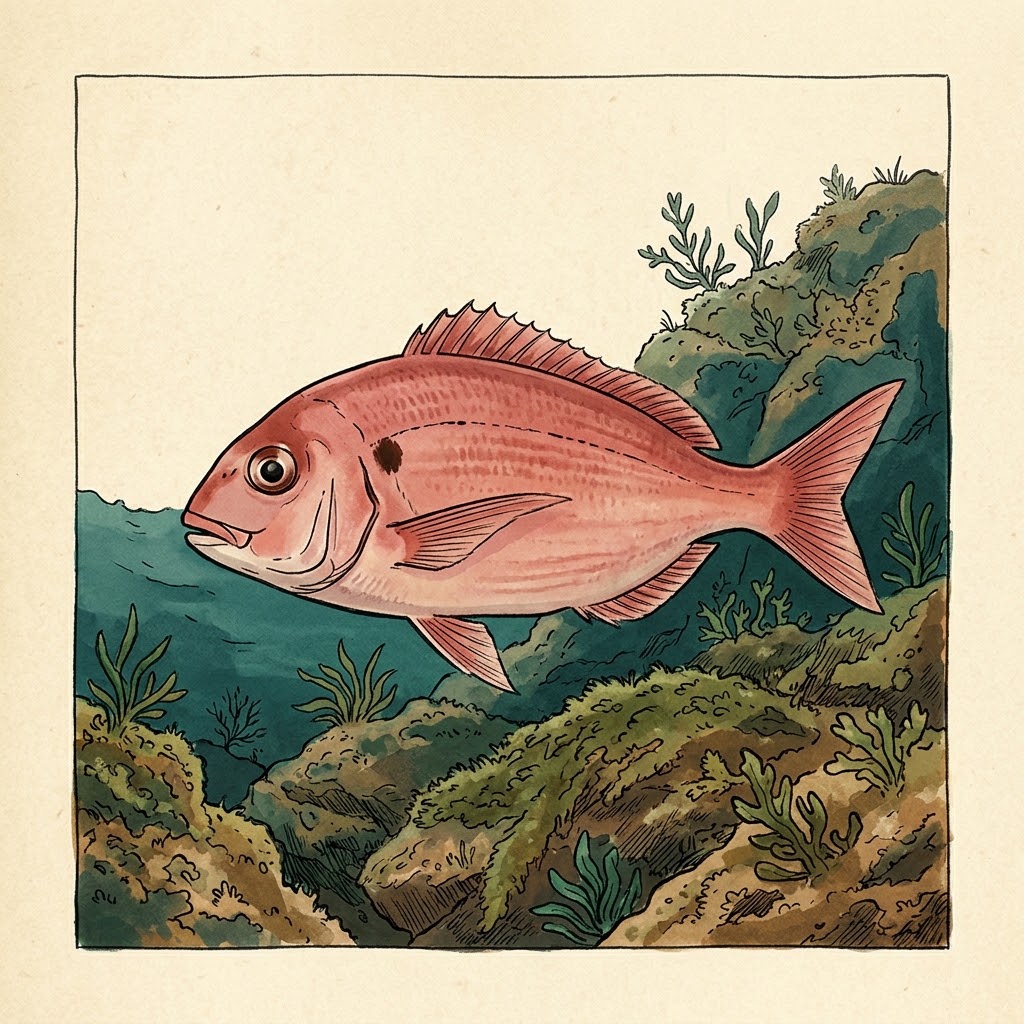
A pink fish with big eyes and a black spot above the pectoral fin: that is the besugo. In Madrid it has been the Christmas Eve dish for generations. But the fish has become so scarce and expensive that it is now a once-a-year treat rather than an everyday fish. In the Cantabrian Sea the stock has collapsed since the 1970s.
| Habitat | Rocky and sandy seabeds; young fish close to the coast, adults down to several hundred metres |
| Size | Usually 30–40 cm, up to about 70 cm |
| Active | Mainly at night, when it hunts small animals |
Card I of IV
Ecological passport
| Identification | Deep and oval, pinkish grey with silver, very large eyes and a clear black spot above the pectoral fin, at the start of the lateral line |
| Do not confuse with | The gilthead bream (dorada), which has a golden band between the eyes and no black spot in that position |
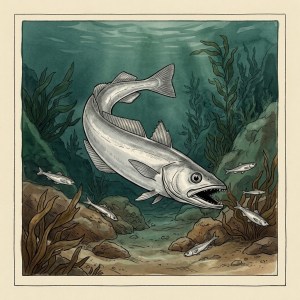
| Diet | Small crustaceans, worms, molluscs and small fish |
Where can you find them?
Difficulty: ●●●●● Hard
Adult besugo live deep. Divers sometimes see young fish over rocks near the coast; otherwise you mostly see it at the fish market.
| Cantabrian Sea | The traditional besugo sea; ports such as Laredo and Castro Urdiales |
| Strait of Gibraltar | Tarifa and Algeciras, where it is called voraz and caught on a line |
| Tip | At the fish market you recognise it straight away by the black spot and big eyes |
Did you know the besugo changes sex? Most fish start life as males and later, once they are bigger, become females.
Card II of IV
Behaviour
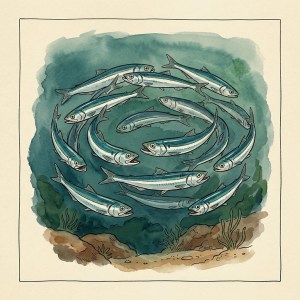
Young besugo live in schools close to the coast, over rocks and seagrass. As they grow older, they move to deeper water along the edges of the continental shelf. They grow slowly and mature late. Because the large, older fish are mostly females, a stock quickly falls out of balance when those big fish are caught. That is one reason the species recovers so slowly.
| Winter | Spawning season in the Bay of Biscay |
| Spring | Larvae and young fish drift towards the coast |
| Summer | Young schools over rocks close to shore |
| Autumn | Adults move to deeper water |
When is the best time to see them?
| Jan | Feb | Mar | Apr | May | Jun | Jul | Aug | Sep | Oct | Nov | Dec |
| deep water | young schools near shore (divers) | move to the deep | |||||||||
■ Good chance ■ Fair chance ■ Hard
Card III of IV
From sea to plate
Besugo used to be caught in large numbers in the Cantabrian Sea. Years of overfishing left little of that. In the Strait of Gibraltar too, where fishers from Tarifa and Algeciras catch the voraz on a line, the stock has declined sharply and strict rules apply. Much of the besugo you buy today comes from other waters or from farms.
If you want to spare the species, eat it only on special occasions, and otherwise choose a sustainably farmed bream or a fish from a healthy stock.
Seasons and preparation vary by region and by year. Ask your fishmonger what is fresh right now, and where the fish comes from.
Card IV of IV
Recipe & tradition
Besugo al horno
| Fish | 1 whole besugo or bream of about 1 kilo, cleaned, with two or three cuts in the side |
| Base | Thin slices of potato and onion, pre-baked for about half an hour with olive oil |
| Bake | Lemon slices in the cuts, the fish on the potatoes, a splash of white wine; about 20 minutes at 200 °C |
| Finish | Fry garlic in oil with a dash of vinegar and parsley, and pour over the fish |
In Madrid, besugo a la madrileña has long been the traditional dish for Nochebuena, Christmas Eve. The fish was brought to the capital from the northern ports, and in December prices rose sharply. The tradition lives on, but because real besugo from the Cantabrian Sea is so scarce, many families now choose another bream or a different fish.
Frequently asked questions
Questions about the blackspot seabream
Why do Spaniards eat besugo at Christmas?
Besugo was at its best in winter and was seen as a festive fish. In Madrid it grew into the classic dish for Christmas Eve.
Is besugo a sustainable choice?
Not really. The wild stock is heavily overfished and recovers slowly. Eat it sparingly and ask where it comes from.
How do you recognise a real besugo?
By the black spot above the pectoral fin, the pink colour and the strikingly large eyes.
Habitat · Spain