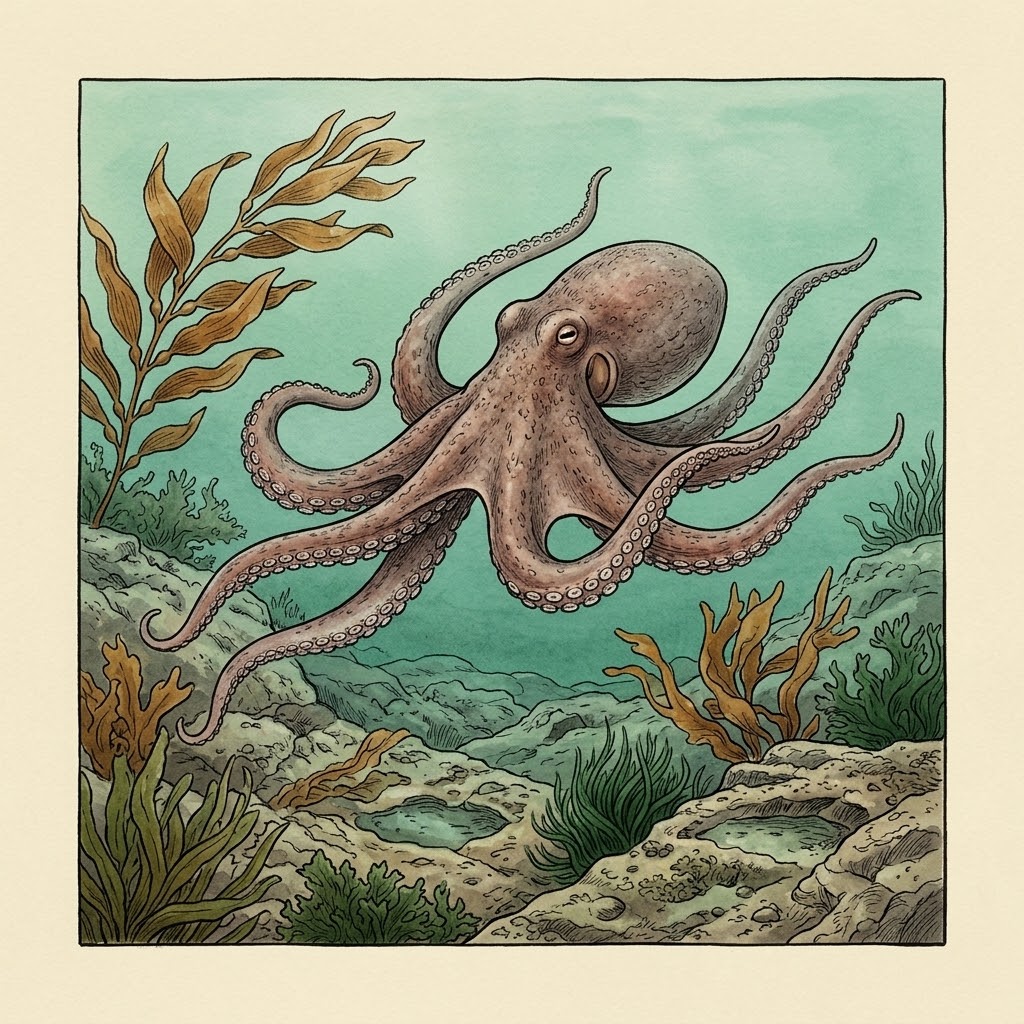
Mollusc · Atlantic coast
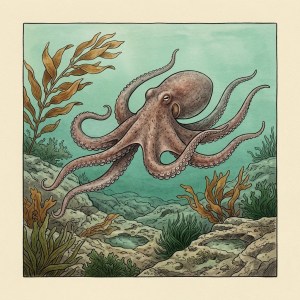
Octopus vulgaris
● IUCN: least concern · choose locally caught
Nowhere in Europe is as much octopus eaten as in Galicia. Every village fiesta has a pulpeira with a steaming copper cauldron. Yet the octopus is also one of the cleverest animals in the sea, and if you snorkel in Galicia’s clear, fjord-like bays you may see one slip away among the rocks.
| Habitat | Rocky seabeds and kelp forests in shallow to medium-deep coastal water |
| Size | Up to about 1 metre including arms; usually 1–3 kg |
| Active | Mostly at dusk and at night |
Card I of IV
Ecological passport
| Identification | Soft, rounded body and eight arms, each with two rows of suckers; reddish-brown to grey skin that can change colour and texture |
| Don’t confuse with | The cuttlefish, which has ten arms, two of them long tentacles, and an internal shell |
| Diet | Crabs, mussels, cockles and small fish |
Where can you see them?
Difficulty: ●●●●● Moderate
Snorkelling or diving among rocks; look for a pile of empty shells in front of a den.
| Galicia | Atlantic Islands National Park, especially the Cíes Islands near Vigo |
| Also good | The rocky shores of the Rías Baixas, such as around Cangas and the Ría de Arousa |
| Tip | The water is cool even in summer; a wetsuit makes snorkelling much more pleasant |
Did you know two-thirds of an octopus’s nerve cells are in its arms? Each arm can partly ‘think’ for itself and feel what it touches.
Card II of IV
Behaviour & season
The octopus is solitary and hides by day in a den among the rocks. At dusk it heads out, probing crevices with its arms for crabs and shellfish. It lives only one to two years. After mating, the female lays tens of thousands of eggs in strings on the ceiling of her den, guards them for weeks without eating and dies shortly after the young hatch.
| Spring | Mating season; females look for a den to brood in |
| Summer | Females guard their eggs |
| Late summer | Young octopuses settle on the seabed |
| Winter | Many move to deeper water |
When is the best time to see them?
| Jan | Feb | Mar | Apr | May | Jun | Jul | Aug | Sep | Oct | Nov | Dec |
| cold water · rough sea | spring | snorkel season · best time | autumn | winter | |||||||
■ Good chance ■ Fair chance ■ Difficult
Card III of IV
From sea to plate
In Galicia small fishing boats catch octopus just off the coast. To keep the stock healthy there is a period of a few months each year, during the breeding season, when octopus fishing is not allowed. Even so, much of the octopus on Spanish plates arrives frozen from North Africa and further afield. Plans for the world’s first octopus farm, in the Canary Islands, have met strong opposition because octopuses are so intelligent.
If you eat octopus, choose locally and small-scale caught where possible, and leave small octopuses alone.
Seasons and preparation vary by region and year. Ask your fishmonger what is fresh right now.
Card IV of IV
Recipe & tradition
Pulpo á feira
| Octopus | A whole octopus, frozen and thawed first so it turns tender |
| Cooking | Dip briefly into boiling water three times so the arms curl, then simmer gently for 30 to 40 minutes |
| Serving | Snipped with scissors onto a wooden board, with coarse sea salt, good olive oil and Spanish paprika |
| On the side | Boiled potatoes (cachelos), bread and a glass of young red wine |
The name means ‘fair-style octopus’: the pulpeiras cooked it at markets and fiestas in large copper cauldrons. Remarkably, the most famous octopus festival comes from a town far from the sea: O Carballiño in Ourense, where the Festa do Pulpo is held every August with tens of thousands of visitors. According to tradition, the monks of Oseira monastery taught the area to eat octopus.
Frequently asked questions
Questions about the octopus in Spain
What is pulpo á feira?
A Galician dish of boiled octopus in slices, with coarse salt, olive oil and paprika, served on a wooden board.
Where can you see octopuses in Spain?
Snorkelling or diving along rocky coasts, for example at the Cíes Islands in Galicia or along the Mediterranean coast.
Why is octopus frozen first?
Freezing breaks down the tough connective tissue, so the meat is tender after cooking. In the past octopus was beaten against the rocks for the same reason.
Habitat · Spain