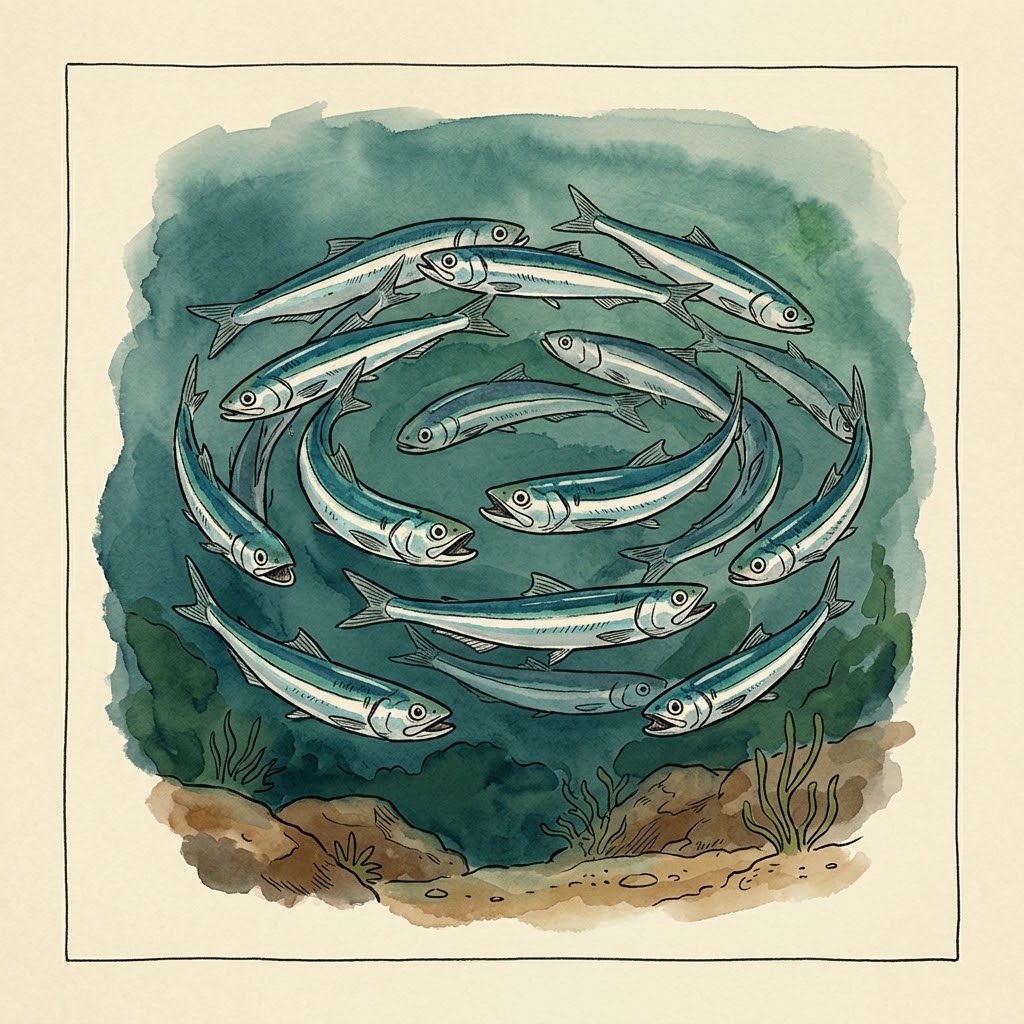
Fish · Atlantic coast
Engraulis encrasicolus
● IUCN: Least Concern · Bay of Biscay stock recovered
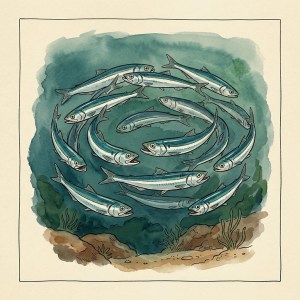
A small silver fish with a big role. In spring, huge schools of anchovy move to the Cantabrian coast to spawn, and the northern harbours start the costera, the anchovy season. In 2005 the stock had collapsed so badly that the fishery had to close for five years. Today the anchovy is back.
| Habitat | Open sea and coastal water, in large schools; close to the shore in spring |
| Size | Usually 10–15 cm, up to about 20 cm |
| Active | Day and night; schools rise towards the surface at night |
Card I of IV
Ecological passport
| Identification | Small and slender, with a blue-green back, a silver stripe along the flank and a strikingly large mouth that reaches behind the eye |
| Do not confuse with | The sardine, which is deeper-bodied, has a smaller mouth and dark spots on the flank |
| Diet | Zooplankton, such as copepods and fish larvae |
Where can you find them?
Difficulty: ●●●●● Hard
You rarely see the schools themselves, but their hunters give them away: diving gannets and dolphins show where they are.
| Cantabria | The harbour of Santoña, the anchovy capital of Spain, and the Bay of Santander |
| Basque Country | The fishing towns of Bermeo, Getaria and Ondarroa |
| Tip | In spring, watch from a cliff for diving seabirds; a school is often underneath |
Did you know a school of anchovy moves like a single body? Thousands of fish turn away at the same moment, so a predator struggles to pick out one fish.
Card II of IV
Life cycle
Anchovies live fast and short: they can spawn after just one year and rarely live longer than three or four years. In spring they seek out the warmer coastal waters, where they release their eggs into open water in the evening. Because they live so briefly, the stock swings strongly from year to year, depending on weather and plankton. That makes good management all the more important.
| March – June | Spawning run to the coast; the costera |
| Summer | Young anchovy grow up in coastal water |
| Autumn | Schools spread out across the bay |
| Winter | In deeper, open water |
When is the best time to see them?
| Jan | Feb | Mar | Apr | May | Jun | Jul | Aug | Sep | Oct | Nov | Dec |
| open sea | costera · close to shore | late summer | winter | ||||||||
■ Good chance ■ Fair chance ■ Hard
Card III of IV
From sea to plate
After years of overfishing and poor recruitment, the anchovy stock in the Bay of Biscay collapsed. From 2005 to 2010 the fishery was closed completely. It then reopened with strict quotas, and the stock recovered well. Anchovy from the Cantabrian Sea is now seen as one of the more sustainable fish from Spain.
Anchovy is oily, salty and full of flavour. In Spain you eat it freshly fried, marinated in vinegar as boquerones, or salted and cured as anchoa in olive oil.
Seasons and preparation vary by region and by year. Ask your fishmonger what is fresh right now. Raw fish you marinate yourself should be frozen first against parasites.
Card IV of IV
Recipe & tradition
Boquerones en vinagre
| Fish | 500 g fresh anchovies, cleaned and filleted, frozen first for at least five days |
| Marinade | White wine vinegar with a little water and salt; marinate the fillets for a few hours until they turn white |
| Finish | Drain, lay in a dish with good olive oil, chopped garlic and parsley |
| Serve with | As a tapa, with bread and a cold beer or a glass of fino |
Spain’s most famous anchovies come from Santoña in Cantabria. At the end of the nineteenth century, Sicilian salters settled there and brought the technique of curing anchovies in salt for months, then cleaning them by hand and laying them in oil. The small canneries of Santoña still work this way. In the south, fresh anchovies are called boquerones, and marinated in vinegar they are one of Andalusia’s best-known tapas.
Frequently asked questions
Questions about the anchovy
What is the difference between anchoas and boquerones?
It is the same fish. Anchoas are salted, cured and packed in oil; boquerones are fresh anchovies, often marinated in vinegar.
Is anchovy from the Bay of Biscay sustainable?
After the fishery was closed from 2005 to 2010, the stock recovered and is now fished under quotas. It is currently considered a good choice.
Where do the best Spanish anchovies come from?
From the Cantabrian Sea, and above all from Santoña, where they are still cleaned and packed by hand.
Habitat · Spain