Guide · France · All year
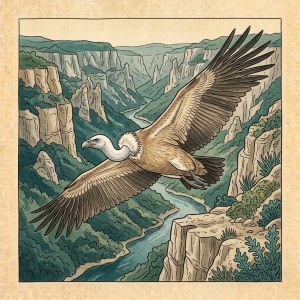
Dozens of vultures circling without a single wingbeat above limestone cliffs hundreds of metres high: in the Gorges de la Jonte, in the south of the Massif Central, that is normal on a sunny day. Nowhere in Western Europe do you get so close to vultures so easily. This guide tells you where to look, when to go and how, with some luck, to see all four European vulture species.
Short answer: go to the Gorges de la Jonte, the gorge between Le Rozier and Meyrueis (Lozère and Aveyron). Watch from the Belvédère des Vautours at Le Truel (open from late March to early November, closed on Mondays) or from the lay-bys along the road through the gorge. Come between 10 am and 4 pm on a sunny day, when the vultures rise on the warm air along the cliffs.
Four kinds of vulture
All four European vulture species breed or wander in the Grands Causses. Three were reintroduced here after they had disappeared; the fourth came back on its own.
| Species | In the Grands Causses | How to recognise it |
|---|---|---|
| Griffon vulture | About 820 breeding pairs (2021); reintroduced in the 1980s | Sandy brown with dark flight feathers and a bare, pale head; often flies in groups |
| Cinereous vulture | 29 breeding pairs (2021); reintroduced from 1992 | Bigger and almost uniformly dark brown; usually alone or a few among the griffons |
| Egyptian vulture | A few breeding pairs; returned on its own and is only here in summer | Much smaller, white with black wing edges and a yellow face |
| Bearded vulture | Reintroduced since 2012; about 30 birds released by 2021, still rare | Long, narrow wings and a wedge-shaped tail; orange-tinged breast in adults |
Where to watch
| Spot | What you do there | Good to know |
|---|---|---|
| Belvédère des Vautours, Le Truel | Viewing terrace with telescopes and an exhibition about vultures, right opposite the cliffs | Open from late March to early November, closed on Mondays. Entry around €8 for adults in 2025 |
| Lay-bys in the Gorges de la Jonte | Stop and scan the slopes and the sky | Free and possible all year; you may also see a cinereous vulture perched on a rock |
| Walk À la rencontre des vautours, Le Rozier | 9.3 km loop along the cliffs of the Jonte | About 4.5 hours and some 600 metres of climbing; starts at the car park on the road to Capluc |
| Causse Noir and Causse du Larzac | Waymarked trails across the plateaus | Quieter than the gorge; vultures soar over the sheep pastures |
Heading to the Pyrenees? You can see many griffon vultures there too, for example in the Vallée d’Ossau. Read more on the griffon vulture page.
When to go
| Period | What you see |
|---|---|
| December – February | Display flights of the griffons and laying of the single egg. Fewer thermals and the Belvédère is closed, but the vultures stay: watch from the road |
| March – May | Breeding season. The Egyptian vultures return from Africa; a good chance of all four species |
| June – August | Plenty of thermals and young vultures on the ledges. Busy on the road, so come early |
| September – November | Young vultures fledge, calm weather and fewer tourists |
Time of day matters more than season. Early in the morning the vultures are still on the rocks. As soon as the sun warms the cliffs, usually from around 10 am, they take to the air, and until about 4 pm you see them best. On a cloudy, cold day they often stay put.
Vulture and shepherd
There are so many vultures here thanks to the sheep farmers. On the Causses, farmers take dead sheep to fixed feeding sites, where the vultures clear them up; in 2021 there were more than a hundred. Vulture and shepherd work together: the farmer doesn’t have to pay for the carcass to be collected, and the vultures get food.
How to watch without disturbing
- Stay on waymarked trails and existing climbing routes; the nesting ledges are in the cliffs.
- Don’t approach a vulture on the ground or on a rock, and photograph flying birds from a distance.
- Seen a ringed or tagged vulture, or a bearded vulture? Report it to LPO Grands Causses or the Parc national des Cévennes.
What to bring
Binoculars are enough for the griffons, which often glide right over your head along the rim of the gorge. To pick out a cinereous or bearded vulture among the group, a telescope helps. Wear sturdy shoes for the trails, and in summer bring water and a sun hat: it gets hot in the gorge.
Frequently asked questions
Questions about vulture watching
Where can you see vultures in France?
Most easily in the Gorges de la Jonte and the Gorges du Tarn in the Grands Causses, and in the western Pyrenees, such as the Vallée d’Ossau.
When is the Belvédère des Vautours open?
From late March to early November, from 10 am to 5 or 6 pm, closed on Mondays. Check the current times before you go. In winter you can watch the vultures for free from the road through the gorge.
What time of day do you see most vultures?
Between about 10 am and 4 pm on a sunny day, when the sun warms the rocks and the vultures rise on the rising air.
Can you see all four European vulture species?
Yes, in the Gorges de la Jonte it is possible: griffon, cinereous, Egyptian and bearded vulture. You almost always see griffons; Egyptian vultures only in summer, and the bearded vulture is still rare.
Are vultures dangerous?
No. Griffon vultures eat carrion and don’t attack people. They are big and impressive but shy: keep your distance and they stay calm.
Habitat · France