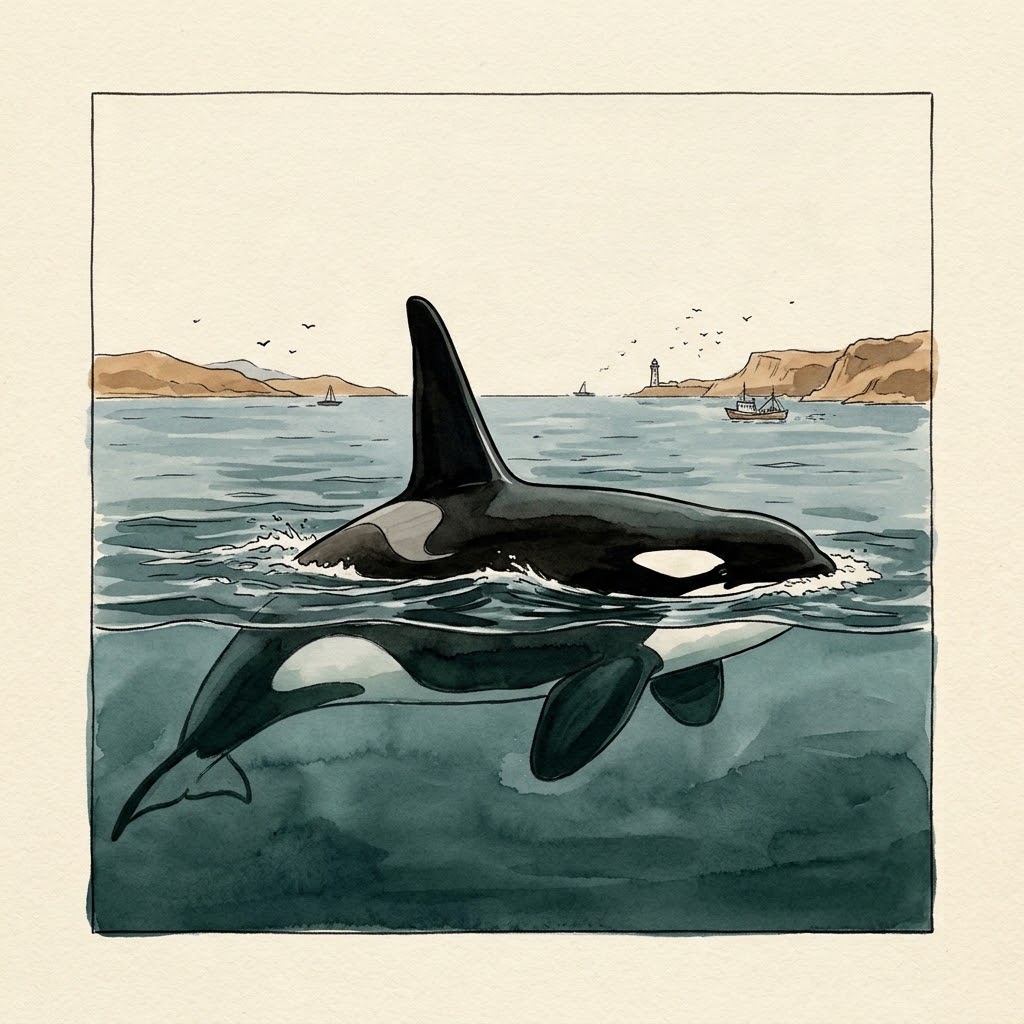
Mammal · Mediterranean & Strait of Gibraltar
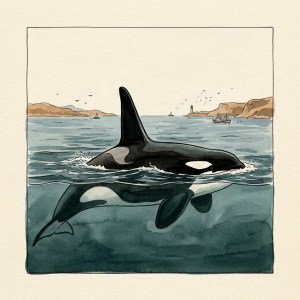
Orcinus orca
● IUCN: Critically Endangered (Strait of Gibraltar subpopulation)
In the narrow strait between Spain and Morocco lives a small, remarkable group of orcas. They follow the bluefin tuna on its migration, and they are so few that they rank among the most threatened orcas in the world. At the last full count in 2011 there were about 39 animals. Anyone who sees them surface from a boat out of Tarifa never forgets it.
| Habitat | The Strait of Gibraltar and the Gulf of Cádiz, and in summer further along the Atlantic coast |
| Size | Males 6–8 metres, females slightly smaller |
| Active | Day and night |
Card I of IV
Ecological passport
| Identification | Black with a white belly, a white patch behind the eye and a grey ‘saddle’ behind the dorsal fin; males have an upright dorsal fin up to almost 2 metres tall |
| Do not confuse with | The long-finned pilot whale, which is also black but has a low, curved dorsal fin and no white patches |
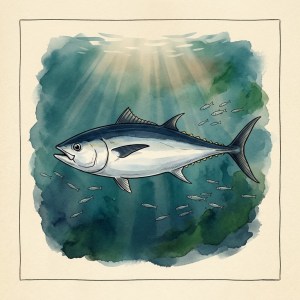
| Diet | Almost exclusively bluefin tuna |
Where can you find them?
Difficulty: ●●●●● Moderate, in the right season
Your chances are best in July and August. Go with a licensed whale-watching operator that follows the rules on distance and speed.
| Tarifa | The southernmost point of Europe, with daily boat trips into the Strait |
| Gulf of Cádiz | In spring around Barbate, where they wait for the migrating tuna |
| Tip | On the same trip in the Strait you often also see pilot whales and dolphins, and sometimes sperm whales |
Did you know researchers know every orca here by name? They recognise the animals by the shape of the dorsal fin and the grey saddle, which differ for each orca.
Card II of IV
Behaviour
Orcas live in close family groups around an older mother, staying together for life. The orcas of the Strait hunt almost only bluefin tuna. Some groups chase a tuna until it is exhausted; others have learned to take tuna from fishers’ lines. They follow the tuna on its migration: the Gulf of Cádiz in spring, the Strait in summer, and then further north along the coast.
Since 2020, some of these orcas have approached sailing boats, pushing against the rudder and sometimes damaging it. Researchers are not yet sure why; it is often seen as play or curiosity.
| March – June | Gulf of Cádiz, where the tuna come in |
| July – August | The Strait of Gibraltar, as the tuna head back out |
| Autumn | Further north along the Atlantic coast |
| Winter | Largely unknown; they are rarely seen then |
When is the best time to see them?
| Jan | Feb | Mar | Apr | May | Jun | Jul | Aug | Sep | Oct | Nov | Dec |
| rarely seen | Gulf of Cádiz | Strait · from Tarifa | heading north | ||||||||
■ Good chance ■ Fair chance ■ Hard
Card III of IV
Role in the ecosystem
As an apex predator, the orca sits at the top of the food chain. Because this group eats almost nothing but tuna, its fate depends entirely on the tuna. When the tuna stock collapsed around 2000, the orcas struggled; now that the tuna is recovering, hunting is going better again. But with so few animals, every orca lost is a major loss.
Threats: too little food, pollutants that build up in their bodies, underwater noise and heavy shipping in one of the busiest straits in the world. On top of that, the group is so small that few calves are born. Since 2019 the group has been on the IUCN Red List as Critically Endangered, with fewer than fifty adults.
You can help by only going out with licensed whale-watching operators that keep their distance and run their engines gently. Sailors receive guidance from the Spanish government on what to do if orcas approach their boat.
Card IV of IV
Stories & culture
In Spanish the orca is called orca, but in the past also ballena asesina, ‘killer whale’. The name came from sailors who saw orcas hunting large prey. Today people in Tarifa see them very differently: the orcas are the stars of whale watching, and researchers give each animal its own name.
The fishers on this coast have known the orcas for centuries, because they follow the same tuna. Since the encounters with sailing boats, the Iberian orcas have become world news. In Spain, journalists sometimes call them the ‘Gladis’ gang, after one of the first females seen at the rudders.
Frequently asked questions
Questions about the orca
How many orcas live in the Strait of Gibraltar?
At the last full count in 2011 there were about 39. The group is listed as Critically Endangered.
When can you see orcas from Tarifa?
Mainly in July and August, when the tuna swim back out of the Strait.
Why do orcas push against sailing boats?
That is not yet certain. Researchers often think of play or curiosity rather than aggression.
Read whale watching from Tarifa.
Habitat · Spain