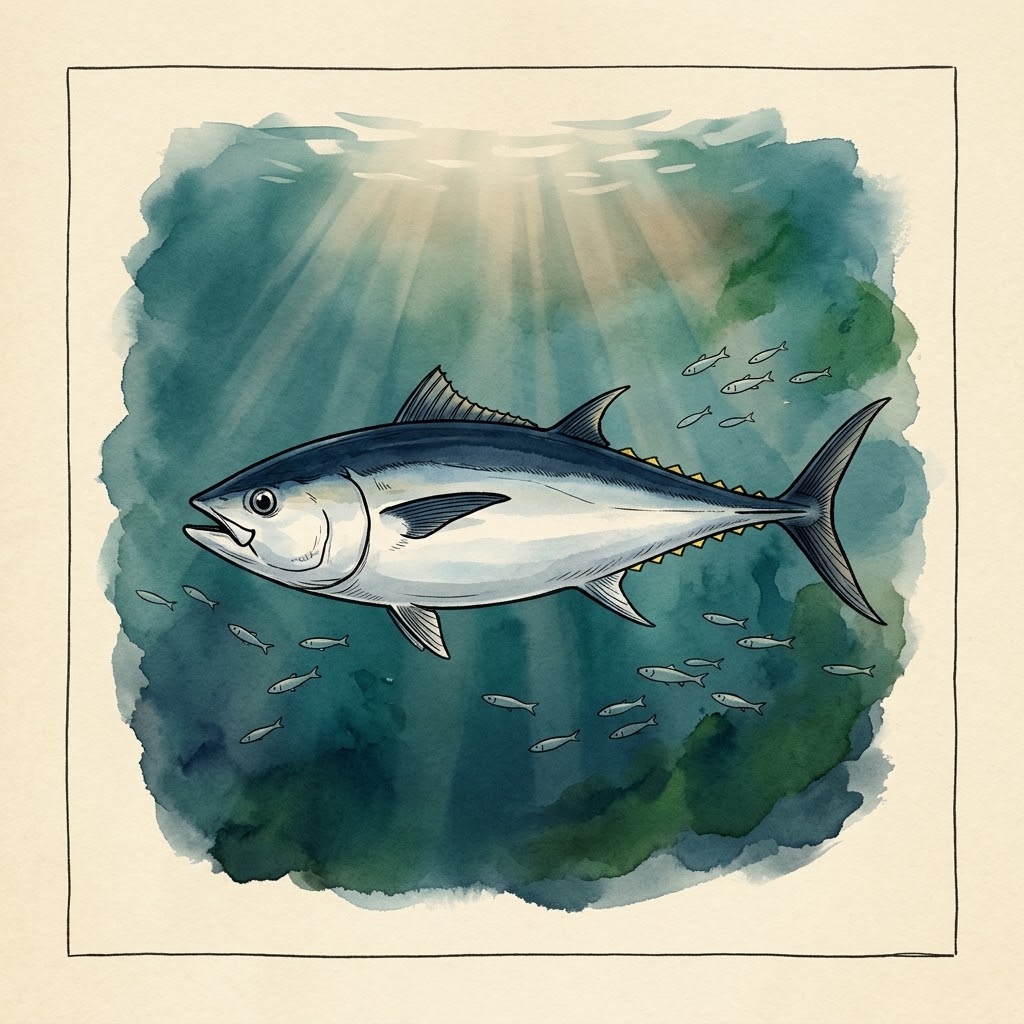
Fish · Mediterranean & Strait of Gibraltar
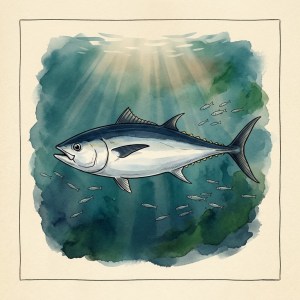
Thunnus thynnus
● IUCN: Least Concern since 2021 · recovered thanks to strict quotas
A fish as big as a horse that swims faster than almost any other fish. Every spring, bluefin tuna travel from the Atlantic through the Strait of Gibraltar into the warm Mediterranean to spawn. Since ancient times, life in coastal towns such as Barbate and Zahara de los Atunes has revolved around this migration.
| Habitat | Open ocean; in spring through the Strait of Gibraltar into the Mediterranean |
| Size | Adults usually 2–2.5 metres and 200–400 kilos, sometimes larger |
| Active | Day and night; it never stops swimming |
Card I of IV
Ecological passport
| Identification | Torpedo-shaped, dark blue back, silver belly, short pectoral fins and a row of small yellow finlets just before the crescent-shaped tail |
| Do not confuse with | The albacore, which stays much smaller and has very long pectoral fins |
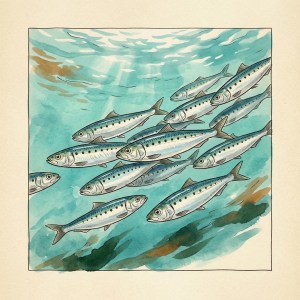
| Diet | Schooling fish such as mackerel, sardine and anchovy, and squid |
Where can you find them?
Difficulty: ●●●●● Hard
With some luck you may see tuna leaping from the water from a whale-watching boat as they hunt schools of fish.
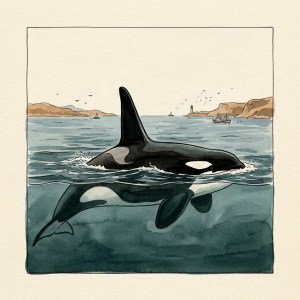
| Strait of Gibraltar | Boat trips from Tarifa, where you sometimes also see orcas hunting tuna |
| Cádiz | Barbate, Zahara de los Atunes and Conil, the tuna villages of the Cádiz coast |
| Tip | Visit Barbate in May, when the tuna weeks with tastings take place in the restaurants |
Did you know the bluefin tuna is warmer than the water around it? It keeps its muscles warm, so it can hunt fast in both cold and warm seas.
Card II of IV
Behaviour
Bluefin tuna are true long-distance swimmers: some cross the entire Atlantic. The eastern population spawns in the warm Mediterranean, including around the Balearic Islands. To get there, they swim in groups through the Strait of Gibraltar from April to June, fat and strong. After spawning, in summer, they head back to the ocean, leaner than on the way in.
| April – June | Inward migration through the Strait of Gibraltar |
| June – July | Spawning in the Mediterranean, including near the Balearics |
| July – August | Return migration to the Atlantic |
| Autumn – winter | Out in the ocean, feeding |
When is the best time to see them?
| Jan | Feb | Mar | Apr | May | Jun | Jul | Aug | Sep | Oct | Nov | Dec |
| in the ocean | inward run | return run | in the ocean | ||||||||
■ Good chance ■ Fair chance ■ Hard
Card III of IV
From sea to plate
Around the year 2000, bluefin tuna were so heavily overfished that scientists feared for the species’ future. From 2007, strict quotas, a minimum size and better controls were introduced. It worked: the stock recovered so well that in 2021 the IUCN moved the species from threatened to Least Concern. Management remains strict, though.
On the Cádiz coast, tuna has traditionally been caught with the almadraba, a tradition dating back to the Phoenicians. Every part of the fish has its own name and its own dish, from the fatty belly (ventresca) to the dark meat.
Seasons and preparation vary by region and by year. Ask your fishmonger what is fresh right now.
Card IV of IV
Recipe & tradition
Atún encebollado
| Fish | 600 g tuna in thick cubes |
| Onion | 4 large onions in strips, stewed very slowly in olive oil with garlic and a bay leaf until soft and sweet |
| Flavour | A splash of fino or white wine and a pinch of paprika |
| Finish | Stew the tuna briefly with the onions, just until cooked; no longer, or it turns dry |
In Barbate and Zahara de los Atunes, tuna is more than a fish: it is the history of the village. In spring, tuna routes with tastings draw thousands of visitors. Barbate is also famous for its mojama, salted and wind-dried tuna loin, eaten in thin slices with a little olive oil and almonds. Preserving fish with salt on this coast goes back to Roman times, when fish-salting factories already stood here, such as at nearby Baelo Claudia.
Frequently asked questions
Questions about the bluefin tuna
Is bluefin tuna still endangered?
Not according to the IUCN: since 2021 it has been listed as Least Concern, thanks to strict quotas. Management remains strict, though.
What is mojama?
Salted and dried tuna loin, a speciality of Barbate and the Cádiz coast. It is eaten in thin slices.
When does the tuna pass the Cádiz coast?
On the way into the Mediterranean from April to June, and back to the ocean in July and August.
Habitat · Spain