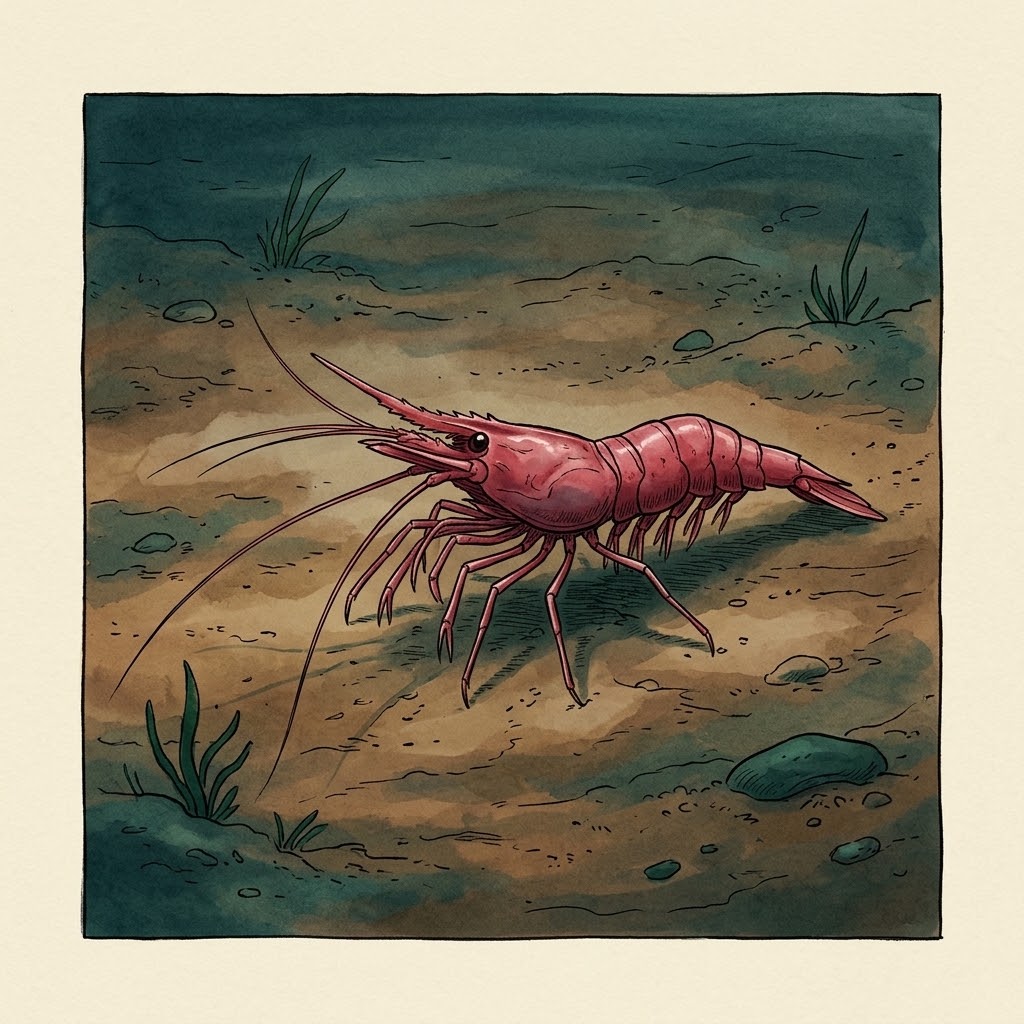
Crustacean · Mediterranean
Aristeus antennatus
● Sensitive to overfishing · local management plan
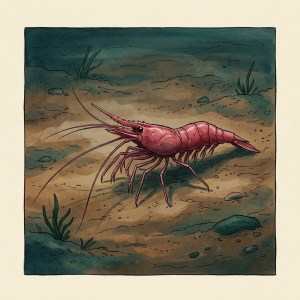
Deep below the waves of the Costa Brava, where no light reaches, lives a red-purple shrimp with antennae three times as long as its body. This is the gamba roja, and the one from the fishing town of Palamós is regarded as one of the finest shrimps in the world.
| Habitat | Muddy seabeds and submarine canyons, usually between 400 and 800 metres deep |
| Size | Females up to about 20 cm, males smaller |
| Active | Day and night, in total darkness |
Card I of IV
Ecological passport
| Identification | Bright red to purple, with a bluish sheen on the head, a long pointed rostrum and extremely long red antennae |
| Do not confuse with | The carabinero, a larger deep-sea prawn that is deep scarlet all over |
| Diet | Small crustaceans, worms and remains that sink to the seabed |
Where can you find them?
Difficulty: ●●●●● Impossible in the wild
This shrimp lives far too deep to be seen. Go to the Palamós fish auction in the afternoon, when the boats come in.
| Palamós | The harbour, the fish auction and the Museu de la Pesca, the fishing museum on the quay |
| Costa Brava | Roses and Blanes are also well-known gamba ports |
| Tip | In the afternoon you can watch the boats come in at the harbour of Palamós |
Did you know red is camouflage in the deep sea? Red light does not reach those depths, so a red shrimp is practically invisible down there.
Card II of IV
Behaviour
The blue and red shrimp lives on and just above the muddy floor of the deep sea, often in the submarine canyons that plunge into the depths just off the Catalan coast. It feels its way around with its long antennae. In summer, females gather in larger groups in somewhat shallower water to spawn; in winter they are deeper and more scattered. Females grow larger and live longer than males.
| Winter | Deeper and scattered in the canyons |
| Spring | Females move to the canyon edges |
| Summer | Spawning season; large groups of females together |
| Autumn | Slowly back to deeper water |
When can you find them fresh?
| Jan | Feb | Mar | Apr | May | Jun | Jul | Aug | Sep | Oct | Nov | Dec |
| often closed | spring | peak season | autumn & holidays | ||||||||
■ Good chance ■ Fair chance ■ Hard
Card III of IV
From sea to plate
Because the shrimp lives so deep, the fishery is hard on the seabed and vulnerable to overfishing. In Palamós and Roses, fishers and scientists therefore work together on their own management plan, with fewer fishing days, a larger mesh size and periods without fishing. It is one of the first examples in Spain where fishers themselves help decide on management.
The real gamba de Palamós carries its own quality label. It is auctioned on the day it is caught and is therefore very fresh. The taste is sweet and briny, and the head in particular is full of flavour.
Seasons and preparation vary by region and by year. Ask your fishmonger what is fresh right now.
Card IV of IV
Recipe & tradition
Gambas a la plancha
| Shrimp | Whole fresh red shrimp, with head and shell |
| Plate | A cast-iron griddle or pan, very hot, with a thin film of olive oil |
| Cook | Coarse sea salt on top and only a minute or a minute and a half per side; they should stay glassy inside |
| Eat | With your hands: pull off the head and suck out the juice; that is where most of the flavour is |
In Palamós the gamba is the town’s proud symbol. Every June there is a gamba festival with tastings, and the restaurants around the harbour offer special menus. Connoisseurs eat it as pure as possible, without garlic or sauce, so you taste the sweetness of the shrimp. If you want to learn more about fishing life, visit the Museu de la Pesca on the harbour.
Frequently asked questions
Questions about the blue and red shrimp
Why is gamba de Palamós so expensive?
It is caught at great depth, in small quantities, on a limited number of fishing days, and sold fresh the same day.
How deep does the blue and red shrimp live?
Usually between 400 and 800 metres, but it also occurs much deeper.
What is the best way to eat it?
As simply as possible: briefly on a hot griddle with coarse salt. And don’t forget the juice from the head.
Habitat · Spain