Bird · Wetlands
Porphyrio porphyrio
● IUCN: least concern · EU Birds Directive Annex I
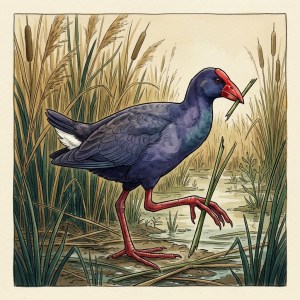
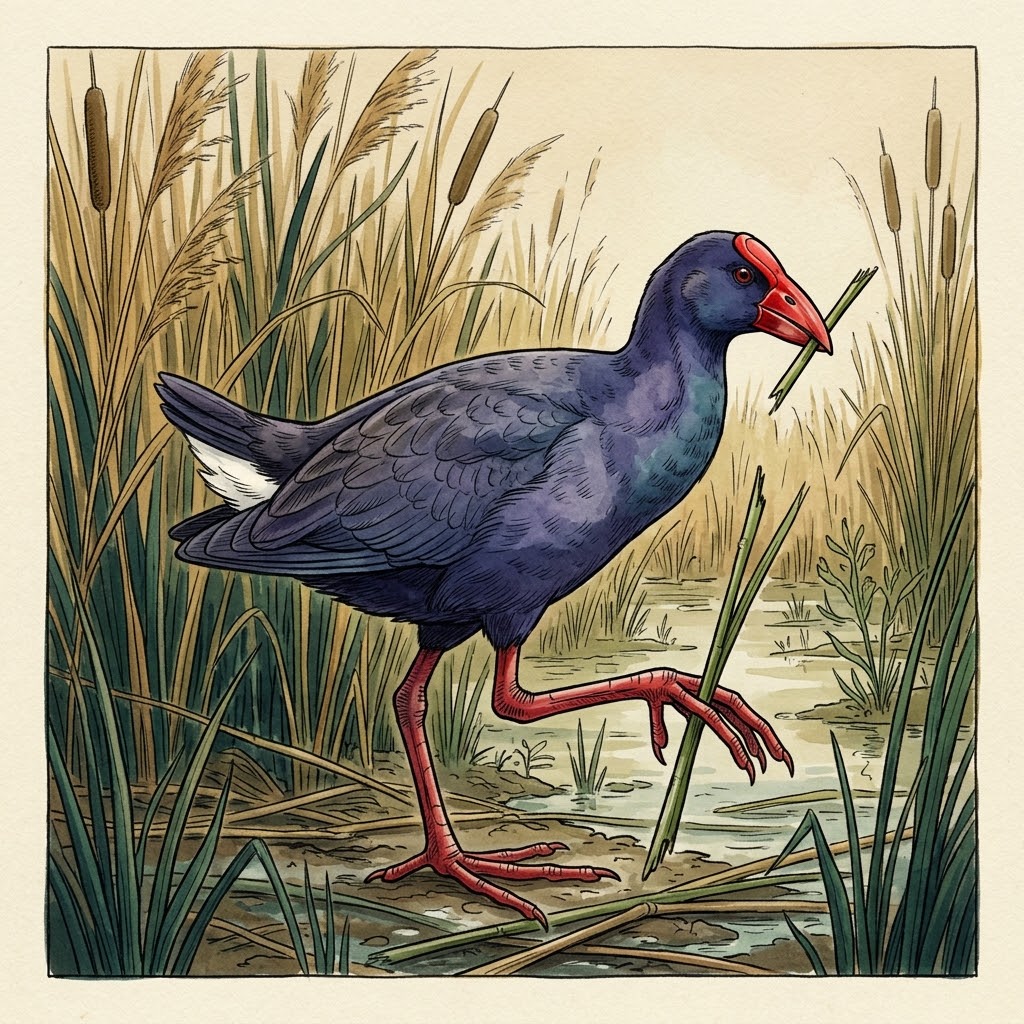
A chicken in a purple-blue evening suit, with a bright red bill and red legs. The western swamphen is one of Spain’s most eye-catching birds. In the 1960s it survived only in the marshes of Doñana. Today it is back in many Spanish wetlands, eating reed stems that it holds in its foot.
| Habitat | Reedbeds, bulrush stands and marshes with shallow fresh or brackish water |
| Size | 45–50 cm; 0.6–1 kg |
| Active | By day, especially morning and evening at the edge of the reeds |
Card I of IV
Ecological passport
| Identification | Deep purple-blue bird with a large, bright red bill and red frontal shield, long red legs and white under the tail |
| Don’t confuse with | The moorhen, which is much smaller and darker with a red-and-yellow bill, or the coot with its white bill |
| Diet | Mainly young shoots and roots of reed and bulrush; sometimes snails, insects or an egg |
Where can you see them?
Difficulty: ●●●●● Fairly easy
From a bird hide you often see them foraging at the edge of the reeds, especially early in the day.
| Andalusia | Doñana: the José Antonio Valverde visitor centre and El Acebuche, and the Brazo del Este near Seville |
| Also good | The Albufera of Valencia, the Ebro Delta and s’Albufera on Mallorca |
| Tip | Listen for its loud, trumpeting call; you often hear it before you see it |
Did you know a swamphen eats like a parrot? It grabs a reed stem with its foot, lifts it to its bill and nibbles out the soft core.
Card II of IV
Behaviour & season
Swamphens are residents: they stay in the same marsh all year. They live in pairs or small family groups and noisily defend their patch of reeds. The nest is a platform of bent reed stems, hidden in dense vegetation. The downy black chicks are fed by the whole group, sometimes including older brothers and sisters.
| February – March | Display and calling, territories defended |
| April – June | Breeding; black chicks in the reeds |
| Summer | Families at the water’s edge |
| Autumn – winter | Quieter, but present all year |
When is the best time to see them?
| Jan | Feb | Mar | Apr | May | Jun | Jul | Aug | Sep | Oct | Nov | Dec |
| winter | calling & breeding · best time | present all year | |||||||||
■ Good chance ■ Fair chance ■ Difficult
Card III of IV
Role in the ecosystem
The swamphen is the marsh’s gardener. By nibbling down reed and bulrush it opens up gaps in dense reedbeds where other waterbirds can feed. Its presence shows a wetland is healthy: it needs clean water and broad reed fringes. It is itself prey for marsh harriers and foxes.
A comeback: drainage of marshes and persecution made the swamphen disappear from almost all of Spain. It held on only in the Guadalquivir marshes. Thanks to protection, wetland restoration and releases in places such as the Albufera of Valencia and the Ebro Delta, it can now be seen in many places again.
Card IV of IV
Stories & culture
The Romans’ purple bird
The name porphyrio comes from the Greek word for purple, the colour of emperors. The ancient Greeks and Romans kept swamphens as ornamental birds in their gardens and villas, and writers such as Pliny described how the bird eats with its foot. In Spanish it is called calamón.
Frequently asked questions
Questions about the western swamphen
Where can you see swamphens in Spain?
In Doñana, the Brazo del Este near Seville, the Albufera of Valencia, the Ebro Delta and s’Albufera on Mallorca.
What does a swamphen eat?
Mainly young shoots of reed and bulrush, which it holds in its foot. Sometimes also snails, insects or eggs.
Is the swamphen related to the coot?
Yes, both belong to the rail family. The swamphen is much larger and more colourful.