Bird · Wetlands
Phoenicopterus roseus
● IUCN: least concern · depends on wet years
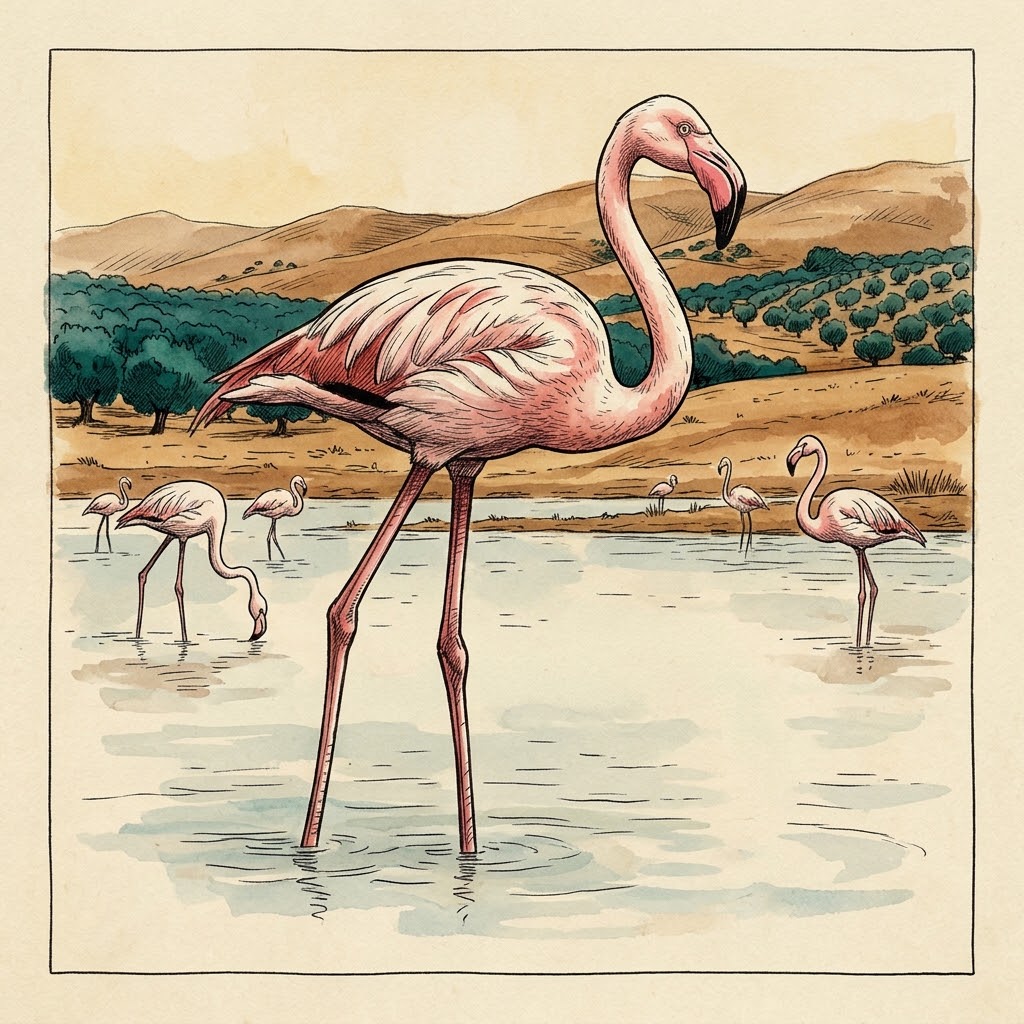
A salt lake in the interior of Málaga, surrounded by olive groves, that turns pink in spring. The Laguna de Fuente de Piedra is the largest flamingo colony on the Iberian Peninsula. In 2026 more than 35,000 pairs bred there, the highest number since counts began.
| Habitat | Shallow salt lakes, lagoons, salt pans and estuaries |
| Size | 120–145 cm tall, wingspan up to 165 cm; 2–4 kg |
| Active | Day and night; they often fly between lakes in the dark |
Card I of IV
Ecological passport
| Identification | Pinkish-white bird with very long legs and neck, a bent pink bill with a black tip, and red and black wings in flight |
| Don’t confuse with | The lesser flamingo, which is much smaller and deeper pink with a dark red bill; it is only occasionally seen in Spain |
| Diet | Brine shrimp, insect larvae, tiny snails and algae, sieved from the water |
Where can you see them?
Difficulty: ●●●●● Easy
In a wet spring you see thousands of flamingos at once at Fuente de Piedra, straight from the visitor centre.
| Andalusia | Laguna de Fuente de Piedra (Málaga): the visitor centre and the Cerro del Palo viewpoint |
| Also good | Doñana, the Marismas del Odiel near Huelva and the Ebro Delta in Catalonia |
| Tip | Bring binoculars; the colony itself is in the middle of the lagoon and off limits |
Did you know flamingos turn pink because of what they eat? Pigments in brine shrimp and algae colour their feathers. Young flamingos are grey.
Card II of IV
Behaviour & season
Flamingos live in flocks and breed in large colonies on islands in the water. In spring they march back and forth in tight groups with necks stretched: the group display. Each pair builds a cone of mud and lays one egg on top. The grey chicks later gather in ‘crèches’ guarded by a few adults. Whether they breed at all depends on the rain: in dry years the lagoon dries out and the colony stays empty.
| February – March | Arrival and group display |
| April – May | Incubating on mud nests |
| June – July | Grey chicks in crèches |
| Autumn – winter | Many birds move to other wetlands or to Africa |
When is the best time to see them?
| Jan | Feb | Mar | Apr | May | Jun | Jul | Aug | Sep | Oct | Nov | Dec |
| winter | breeding season · best time | lagoon dries out | autumn & winter | ||||||||
■ Good chance ■ Fair chance ■ Difficult
Card III of IV
Role in the ecosystem
Few animals can live in water saltier than the sea. The flamingo can. With its bill, which works like a sieve, it filters brine shrimp and algae from the water. By trampling the mud with its feet it churns up the bottom. Flamingos also link wetlands together: the same birds breed in Spain, France and Italy, and sometimes winter in North Africa.
It all depends on water: Fuente de Piedra is a temporary lake that only fills with rainwater. Drought and groundwater pumping for farming are the biggest threats. In wet years the colony booms; in dry years almost nothing breeds.
Card IV of IV
Stories & culture
Flamenco by the lake
In Spanish the flamingo is called flamenco, just like the famous Andalusian dance and music. Whether the two words are really connected, nobody knows for sure. The Fuente de Piedra colony became famous through the biologist José Antonio Valverde, after whom the visitor centre is named. Every summer hundreds of volunteers help ring the young flamingos there, so researchers can follow their journeys from West Africa to Cyprus.
Frequently asked questions
Questions about the flamingo in Spain
Where can you see flamingos in Spain?
Best at the Laguna de Fuente de Piedra near Málaga. They are also common in Doñana, the Marismas del Odiel and the Ebro Delta.
When are most flamingos at Fuente de Piedra?
From February to July, in years with enough rain. In late summer the lagoon often dries out and the birds leave.
Why are flamingos pink?
Because of pigments in their food, such as brine shrimp and algae. Young flamingos are still grey.