Mammal · Mountains
Capra pyrenaica
● IUCN: least concern · found only on the Iberian Peninsula
It climbs granite walls as if they were stairs. The Iberian ibex lives only in Spain and a small corner of Portugal, and in mountains like the Sierra de Gredos it is so used to hikers that you sometimes see it a few metres away. Yet its family has a sad story too: one of its subspecies went extinct in 2000.
| Habitat | Rocky mountain slopes, cliffs and alpine meadows, from sea level to over 3,000 metres |
| Weight | Males 60–80 kg, females 35–45 kg |
| Active | By day, especially morning and late afternoon |
Card I of IV
Ecological passport
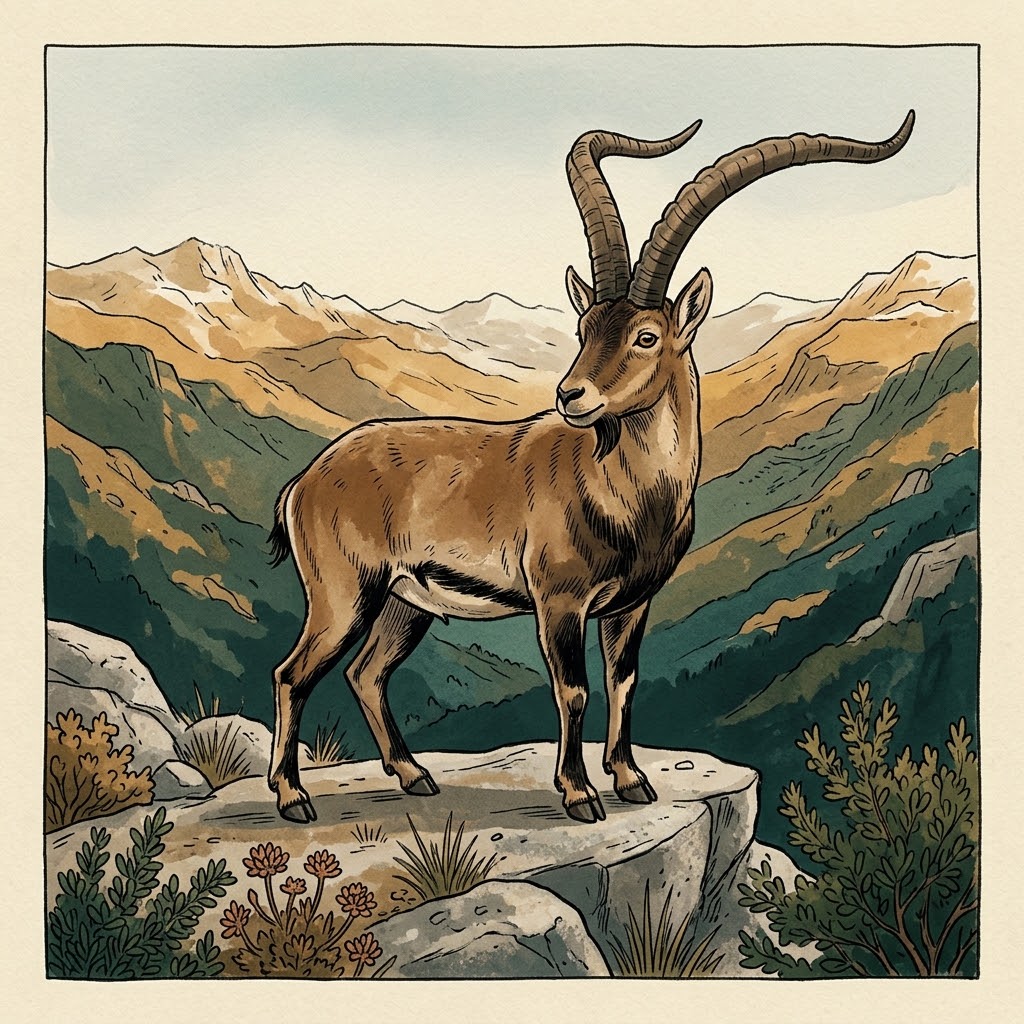
| Identification | Males have long horns that curve outwards and then back, in a lyre or S-shape, and black markings on the legs and flanks; females are paler brown with short horns |
| Don’t confuse with | The Alpine ibex, whose horns sweep straight back in a broad arc with thick knobs; it does not live in Spain |
| Diet | Grasses, herbs, leaves and shrub twigs |
Where can you see them?
Difficulty: ●●●●● Easy
In Gredos and La Pedriza you almost always see them, often close to the path.
| Sierra de Gredos | The walk from the Plataforma de Gredos to the Laguna Grande, below the summit of Almanzor |
| Also good | La Pedriza in the Sierra de Guadarrama near Madrid, and the Sierra Nevada |
| Tip | Never feed them and keep your distance; tame ibex that get food from people fall ill |
Did you know you can read a male’s age from his horns? A growth ring is added every year, just like a tree.
Card II of IV
Behaviour & season
For most of the year males and females live in separate groups. November and December are the rut: the males seek out the females and test their strength, sometimes with loudly clashing horns. In winter the groups move down to lower, sunny slopes. In May and June usually one kid is born, which within hours is already scrambling over the rocks after its mother.
| November – December | Rut; males and females together |
| Winter | Lower down on sunny slopes |
| May – June | Kids are born |
| Summer | High in the mountains, around the summits |
When is the best time to see them?
| Jan | Feb | Mar | Apr | May | Jun | Jul | Aug | Sep | Oct | Nov | Dec |
| winter · lower slopes | kids | summer · high up | rut · best time | ||||||||
■ Good chance ■ Fair chance ■ Difficult
Card III of IV
Role in the ecosystem
As a large grazer, the ibex keeps mountain meadows open and helps shape the vegetation on the slopes. Young ibex are prey for golden eagles, and animals that don’t survive the winter are cleared away by griffon and bearded vultures. That makes the ibex a link in the whole mountain landscape.
From a handful to thousands: around 1900 only a few dozen ibex were left in Gredos. Protection allowed the group to grow to thousands of animals, and Gredos ibex were used to bring the species back to other mountain ranges. Sarcoptic mange, a skin disease caused by mites, is now the biggest threat.
Card IV of IV
Stories & culture
The bucardo: extinct twice
The Pyrenean subspecies, the bucardo, disappeared in January 2000, when the last female, Celia, was found dead in Ordesa. Scientists had stored some of her cells beforehand. In 2003 a cloned bucardo kid was born from them, the first animal ever brought back from an extinct subspecies. It lived only a few minutes. Ibex now live in the Pyrenees again, released from other Spanish mountains.
Frequently asked questions
Questions about the Iberian ibex
Where can you see Iberian ibex?
In the Sierra de Gredos, especially on the route to the Laguna Grande, in La Pedriza near Madrid and in the Sierra Nevada.
How is it different from the Alpine ibex?
The Iberian ibex’s horns curve outwards and back in a lyre or S-shape. The Alpine ibex’s horns sweep back in a broad arc with thick knobs.
What was the bucardo?
The Pyrenean subspecies of the Iberian ibex. It went extinct in 2000; in 2003 a cloned kid was born that lived only a few minutes.